

The process of starting a business in Canada may seem thrilling, but it may also feel daunting.
A large number of businesspeople find it challenging to handle legal documents, vague government regulations, and the risk of committing expensive errors during the establishment.
Personal financial risk is one of the greatest concerns, and more so when business debts begin to mingle with personal savings or assets. A small business problem may easily turn into a personal liability problem without a proper structure.
The good news is that incorporation creates a legal barrier between you and your business. It not only assists in securing your personal resources, but it also provides your business with a strong base to develop. By taking the right steps, you can create a compliant and secure business upfront.
Let’s dive in and understand the exact process step by step.
1. Select Corporate Structure That Protects Personal Assets in Canada
One of the most crucial decisions in opening a business in Canada is the selection of the right business structure. It has a direct influence on the degree of personal risk that you have, on taxation, and on the long-term expansion of your business. Most entrepreneurs fail to undergo this process and end up being exposed to financial liabilities that can be avoided at the outset.
In Canada, there are three main structures to consider:
Sole proprietorship
Easy to establish, and no legal distinction exists between individual and corporate responsibility. This implies that business debts can be covered by personal savings, property, and assets.
Partnership
Involves two or more owners sharing profits, responsibilities, and liabilities. Each partner can be held responsible for business obligations.
Corporation
A distinct legal entity offering limited liability, i.e., the business has its own debt and liability.
Incorporation is the most preferred by most entrepreneurs who are interested in securing personal assets. It establishes a legal distinction between personal and business finances. That is why learning how to incorporate a business in Canada in the right way is the first strategic step to long-term financial stability and organized business development.
2. Register and Incorporate Business Under Federal or Provincial Law

After choosing the appropriate structure, you should then proceed and actually incorporate your business in Canada. This is where your idea or small operation is legally changed to a corporation and has its own rights and responsibilities.
This is where you need to choose between the federal incorporation Canada and the provincial incorporation Canada, depending on where you would like to conduct your business and the extent of protection for your business name.
Federal incorporation enables your business to be used throughout Canada with name protection on a country-wide basis. Whereas provincial incorporation registers and operates in a particular province like Ontario, British Columbia or Alberta.
The incorporation process generally includes several key steps:
- Selecting a unique and compliant business name
- Completing and filing incorporation documents with the government
- Defining your share structure and ownership setup
- Establishing corporate bylaws that guide internal governance
A significant number of business people opt to register a business online Canada due to ease of documentation, less processing time, and error minimization. When this is done, your business turns into an independent entity, and this is crucial in securing personal assets and long-term credibility.
3. Separate Personal Liability from Business Obligations Through Incorporation
Once a business is incorporated in Canada, it is treated as a separate legal entity, distinct from its owner. This separation is one of the strongest advantages of incorporation because it creates a legal and financial boundary between personal and business responsibilities. The corporation itself becomes responsible for its debts, contracts, and obligations, not the individual owner.
This structure is especially important because it reduces personal financial exposure in day-to-day business operations.
Key protection benefits of incorporation include:
- Business debts remain within the corporation
- Personal assets such as home, savings, and investments are generally protected
- Legal claims are directed at the company, not the owner personally
- Business contracts are signed under the corporate name
- Financial risks are isolated from personal finances
However, this protection is not absolute. Personal guarantees on loans, fraudulent activity, or misuse of the corporate structure can still create personal liability.
Courts in provinces like Ontario, British Columbia, and Alberta consistently uphold limited liability when the corporation is properly maintained and compliant.
This is why many entrepreneurs focus on understanding how to incorporate a business in Canada, as it provides both security and long-term operational confidence.
4. Obtain Business Number (BN) and Register CRA Tax Accounts

Once incorporated, the next thing that follows is tax registration with the Canada Revenue Agency (CRA). This step makes sure that your business is registered properly in terms of taxation, payroll, and reporting in Canada.
Business Number (BN) Setup
Business Number (BN) is a single identification number given to the CRA. It is used for all federal business dealings, including taxes and government programs. When you create your corporation, the BN is the key point of reference for your business.
GST/HST Account Registration
You need a GST/HST account with a mandatory level of required revenue or with a voluntary registration to claim input tax credits. This account enables you to accumulate and remit sales tax according to the Canadian tax rules.
Payroll Account Registration
A payroll account is necessary if you hire employees in your business. It also makes sure that income tax, CPP and EI contributions are deducted and remitted to the CRA on behalf of employees.
Corporate Income Tax Account
All the incorporated businesses in Canada are required to submit corporate income tax returns. This record follows your yearly business revenue, expenses, and income taxes with the federal government.
Business Name Registration and Legal Recognition
A business name registration Canada is a well-done process that makes your company legally established and connected to all CRA accounts. It assists in keeping consistency throughout government records and reinforces compliance at the beginning.
Overview of CRA Registration Requirements
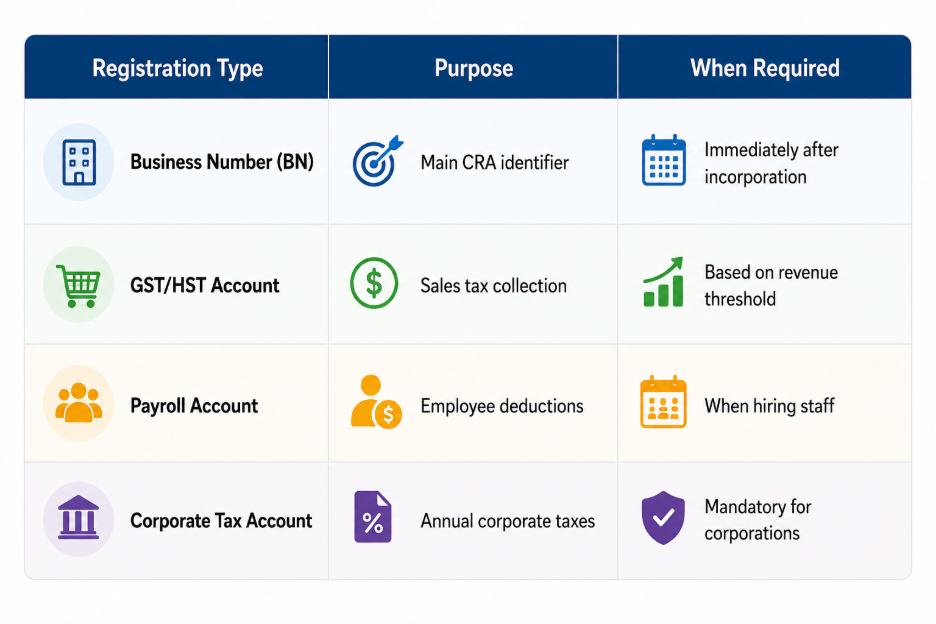
These registrations make sure that your business is operating in full compliance with the Canadian tax laws on the very first day, and there is no penalty or delay in reporting.
5. Meet Ongoing CRA and Legal Compliance Requirements After Incorporation
Compliance is not a one-time process, as it is a continuing endeavor after incorporation. Most business owners would believe that once they have registered the company, it is ready. As a matter of fact, legal and financial compliance is vital in ensuring the corporation remains active, legitimate and fully protected by Canadian law.
Key ongoing requirements include:
- Making annual corporate returns to the corresponding federal or provincial body.
- Keeping accurate and updated records with the CRA for all business activities.
- Monitoring of income, expenses, as well as financial transactions at any time of the year.
- Refilling or renewing provincial registers or filings where necessary according to jurisdiction.
Violation of these obligations may result in penalties, late payment or even loss of good standing status, which may have an impact on your business credibility and legal protection. This is one of the steps many entrepreneurs do not consider when they are taught how to incorporate a business in Canada, but it is very important for long-term stability and continuity of the liability protection.
Adequate compliance makes the corporation remain as a distinct legal person, protecting personal property and preserving confidence with the regulators, banks, and partners.
6. Maintain Corporate Records to Preserve Limited Liability Protection

Maintaining corporate records is a crucial but often overlooked part of running a corporation in Canada. Such records serve as legal evidence that your business is a separate entity, which is crucial to maintaining limited liability coverage. Documents also ensure transparency, compliance, and that financial operations run smoothly over time.
To the entrepreneur who wants to start up a corporation properly, knowing how to incorporate a business in Canada may assist in making sure that all the legal requirements and documents are checked at the very outset.
A corporate minute book typically includes:
- Shareholder contracts that specify ownership rights and duties.
- Recording of key corporate decisions in meetings.
- Banking, funding or investment financial resolutions.
- Share structure amendments to ownership.
- Annual reports are mandated by federal or provincial legislation.
In most provinces, a NUANS report is also a significant pre-incorporation requirement, ensuring that a business name is not available and preventing conflicts or duplication at the time of registration.
Maintaining such records is also important to keep your corporation on the right side of the law when it comes to audits, bank reviews, or governmental inspections. In the absence of documentation, the courts can also lift the veil of incorporation, which can subject personal wealth to business liabilities.
Conclusion
One of the most efficient methods to safeguard personal wealth and create a legal and secure structure to develop is to incorporate a business in Canada. Since it is necessary to determine the appropriate structure or to do CRA registrations and be compliant, every step is essential in the long-term protection. Not only does a well-managed corporation lessen the financial risk, but it also enhances the credibility of the corporation with the banks, investors and clients.
When you are planning to start a business in Canada, it is worth knowing how to incorporate a business in Canada in order to go through the process in an efficient manner and have all the legal requirements in place at the very beginning.
Business Canada assists entrepreneurs in doing the incorporation process right, remaining in compliance, and preventing expensive errors in the first place. Their team makes sure that your business establishment is quick, precise and well in line with the laws of Canada so that you can concentrate on growth without any fear.
FAQs
1. What is the first step in incorporating a business in Canada?
The first step is selecting a business structure, usually a federal or provincial corporation, depending on your goals.
2. Do I need a Business Number after incorporation?
Yes, a Business Number (BN) is required for tax identification and CRA accounts.
3. Does incorporation fully protect personal assets?
In most cases, yes. However, personal guarantees or fraud can still create liability.
4. What is the difference between federal and provincial incorporation?
Federal incorporation allows nationwide name protection, while provincial incorporation limits operations to one province.
5. Why is corporate record-keeping important?
It maintains the legal validity of the corporation and helps preserve limited liability protection.